DON'T JUST MANAGE - ELEVATE YOUR LIFE TODAY

Is It Anxiety or Perimenopause? How to Tell the Difference
New or worsening anxiety in your 40s is often hormonal — not psychiatric. Learn why perimenopause triggers anxiety and why SSRIs aren't always the answer.
5 min read

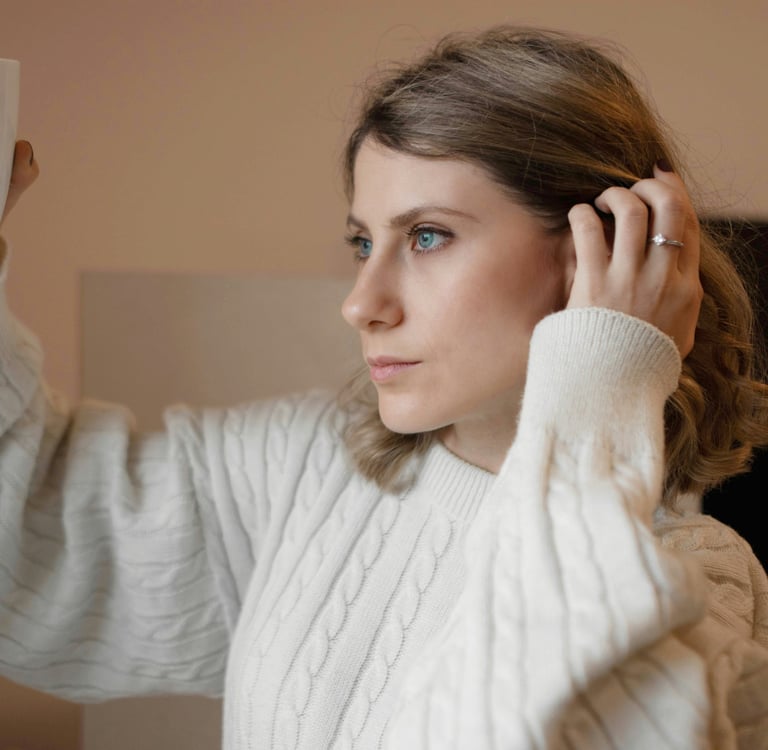
Is It Anxiety or Perimenopause?
How to tell the difference — and why it’s often both
It started gradually. A low hum of unease that didn’t have a name. Then waking at 3am with your heart beating too fast and your mind already racing. Then the day your nervous system felt like it was running a frequency you couldn’t turn down, no matter what you did.
You’ve always been someone who handled stress. This felt different. More physical. More relentless. More like something happening to you than something you were creating.
If you’re in your late 30s or 40s and anxiety has become a new or dramatically worsened feature of your life, there is a biological explanation that most women never receive: declining and fluctuating hormones directly alter the brain chemistry that regulates anxiety, fear response, and emotional resilience. What you’re experiencing may not be a mental health disorder. It may be perimenopause.
That doesn’t mean anxiety isn’t real, or that mental health support isn’t valuable — it absolutely can be. It means the root cause matters, and treating anxiety without addressing a hormonal driver is like treating the smoke alarm without looking for the fire.
Why perimenopause causes anxiety — the biology
Anxiety in perimenopause is not a personality trait, a stress response, or a sign that you can’t cope. It is a neurochemical event driven by hormonal shifts that are happening in your brain and body whether you’re under stress or not.
Progesterone is the first hormone to decline in perimenopause — often years before estrogen shifts meaningfully. This matters enormously for anxiety because progesterone’s primary metabolite, allopregnanolone, is one of the most potent natural modulators of GABA receptors in the brain. GABA is the brain’s primary calming neurotransmitter — the same system targeted by benzodiazepines like Xanax and Valium. When progesterone drops, allopregnanolone drops with it, and the brain loses a significant portion of its built-in anxiety buffer.
Estrogen’s role is equally significant. Estrogen supports serotonin synthesis, increases serotonin receptor sensitivity, and enhances the brain’s ability to regulate mood and emotional reactivity. As estrogen becomes volatile and erratic in perimenopause — spiking high some days, crashing on others — the serotonin system becomes destabilized. The result is mood instability, heightened emotional reactivity, and a nervous system that fires more easily and recovers more slowly.
At the same time, the stress response itself becomes harder to regulate. The HPA axis — the hormonal pathway controlling cortisol and the fight-or-flight response — relies on both estrogen and progesterone to function properly. As those hormones fluctuate, the stress response fires more easily, produces more cortisol, and takes longer to return to baseline. Women describe this as feeling like they’ve lost the ability to just calm down the way they used to. That’s not a character flaw. That’s a physiological change.
How to tell the difference
Anxiety that’s primarily hormonal in origin has some distinctive features that set it apart from generalized anxiety disorder or situational stress — though they can absolutely coexist.
Clues that hormones may be driving your anxiety:
It appeared or significantly worsened in your late 30s or 40s without a clear life trigger
It feels more physical than psychological — chest tightness, racing heart, a buzzing or vibrating sensation in the body
It’s worse in the week before your period and improves — even slightly — after your period starts
It’s accompanied by sleep disruption, particularly waking between 2–4am
It arrives in waves or spikes rather than being constant — tied to hormonal fluctuation
Standard anxiety treatments — therapy, SSRIs, lifestyle changes — haven’t fully resolved it
You feel unlike yourself in a way that’s hard to explain — not just stressed, but neurologically different
Clues that mental health factors are also at play (and worth addressing alongside hormones):
Anxiety has been present since early adulthood or earlier, and perimenopause has worsened it
There are identifiable life stressors, relationship dynamics, or unprocessed experiences driving it
Rumination, catastrophizing, or intrusive thoughts are prominent features
Therapy or CBT has helped in the past, even if it’s not fully working now
Why SSRIs aren’t always the answer
When a woman in her 40s presents to her doctor with new anxiety and sleep disruption, the most common response is a prescription for an SSRI or SNRI — antidepressants that work primarily by increasing serotonin availability.
For some women this helps, at least partially. Estrogen influences serotonin, so anything that boosts serotonin signaling can take some edge off hormonally-driven anxiety. But there are two significant limitations to this approach when the root cause is hormonal.
First: SSRIs don’t address progesterone decline or GABA dysregulation at all. The GABAergic calming pathway — the one that allopregnanolone normally supports — is unaffected by serotonin-targeted medications. A woman whose anxiety is primarily driven by progesterone loss may get partial relief from an SSRI but will continue to have the baseline nervousness, the 3am waking, and the premenstrual deterioration, because those are driven by a completely different neurochemical pathway.
Second: SSRIs can blunt libido, affect emotional range, cause weight changes, and create dependency that’s difficult to taper. If the underlying hormonal cause is never addressed, she may end up on a medication she doesn’t actually need, managing its side effects indefinitely.
None of this means SSRIs are wrong for every woman — they are genuinely appropriate for many. It means they shouldn’t be the first and only response to anxiety in a perimenopausal woman, and that a hormonal evaluation should happen alongside or before a psychiatric prescription.
What actually helps
The most effective approach for hormonally-driven anxiety is one that addresses the root cause directly — the hormonal shifts — while supporting the nervous system’s capacity to regulate itself.
A comprehensive hormone evaluation — looking at progesterone timing, estrogen patterns, cortisol rhythm, and thyroid function together as an interconnected system, not in isolation
Hormone support where appropriate — restoring progesterone, for example, can have a rapid and significant effect on anxiety, sleep, and emotional regulation in women whose decline is the primary driver
Nervous system regulation — the HPA axis and the nervous system are deeply connected. Practices that directly build vagal tone and down-regulate the stress response — including active breathwork — address the physiological anxiety substrate at the neurological level
Mental health support — therapy, particularly somatic or body-based approaches, works beautifully alongside hormone treatment for women navigating the emotional complexity of this transition
Addressing cortisol — if cortisol rhythm is dysregulated, it amplifies every hormonal symptom including anxiety. This is rarely assessed and often the missing piece
The answer is usually: both
Anxiety in perimenopause is rarely purely hormonal or purely psychological. For most women it’s a combination — the hormonal shifts lower the neurological threshold for anxiety, and the real stressors of midlife (career pressures, aging parents, relationship changes, identity shifts) pour through that lowered threshold in ways they never did before.
This means the most complete care addresses both. A hormone evaluation to understand and treat the biological driver. Mental health support to address what’s flowing through the widened gap. And nervous system work to rebuild the regulatory capacity that hormonal change has eroded.
You are not broken. You are not developing a psychiatric disorder. Your brain chemistry has been altered by hormonal shifts that no one explained to you — and that is entirely treatable when someone is looking at the right things.
Ready to get a real answer?
Book a Discovery Call or Initial Consult with Leslie, APRN
Virtual Visit $250 for 60 minutes
www.optimizeandelevate.com
This article is for educational purposes only and does not constitute medical advice. If you are experiencing anxiety or other mental health symptoms, please consult a qualified healthcare provider. If you are in crisis, please contact the 988 Suicide and Crisis Lifeline by calling or texting 988.
What’s actually happening in the brain:
Progesterone decline → less allopregnanolone → reduced GABA tone → less natural calming capacity
Estrogen volatility → destabilized serotonin → heightened emotional reactivity
HPA axis dysregulation → cortisol rises more easily → nervous system stays in high-alert longer
None of this is caused by stress. It’s caused by hormonal changes that alter how the brain regulates itself.
The question worth asking before starting an SSRI:
“Has anyone evaluated whether this anxiety has a hormonal root cause?”
If not — that evaluation should absolutely happen. Not instead of mental health support, but alongside it.
© 2026 Optimize & Elevate LLC. All rights reserved.
The information provided on this website and the use of any products or services purchased through this platform does not create a patient-provider relationship. While I am a Nurse Practitioner, I am NOT YOUR Practitioner. This website is for informational and educational purposes only and is not intended to be a substitute for professional medical advice, diagnosis, or treatment. Always seek the advice of your own personal healthcare provider with any questions you may have regarding a medical condition.